How to Double Sleeve MTG Cards
By Dana Whitfield, MTG player since 1996 · Updated
Double sleeving is the closest thing card protection has to a sealed environment, and it is the standard for Commander decks full of expensive staples. This guide covers the method, the sizing logic that makes it work, and the small mistakes that quietly defeat the whole point.
In this guide
What double sleeving is — the two-layer principle in one minute.
The method, step by step — orientation is everything.
The sizing logic — why the layers must differ in cut.
Mistakes that defeat the seal — and how to check yours.
What Double Sleeving Is
Single sleeving protects a card from contact: fingers, table, other cards. What it does not do is seal. A single sleeve's opening faces up in your hand, and anything that falls or splashes toward the top edge can find its way in. Players who run decks worth hundreds of dollars decided years ago that the answer is a second layer facing the other way, and the practice stuck because it works and costs almost nothing.
The inner layer in the classic setup is a thin, snug soft sleeve. Our penny sleeves measure 2.67 x 3.6 inches, which wraps the standard 2.5 x 3.5 inch Magic card closely enough to serve as the inner layer. The outer layer is whatever you already play with, typically a thicker play sleeve with an opaque back.
The Method, Step by Step
In practice, five steps:
1. Clean hands, flat surface. The one time your card face touches skin oil is while sleeving. Sixty seconds of preparation covers a card that stays sealed for years.
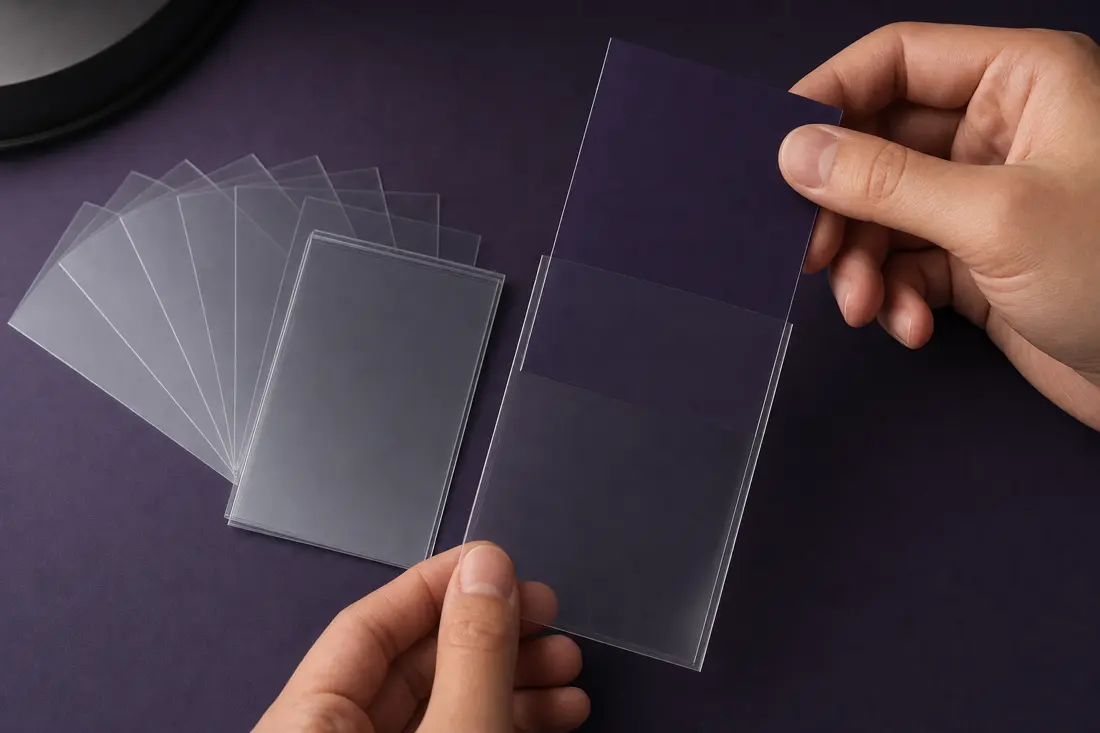
2. Insert the card into the inner sleeve. Push it fully down and press the sleeve flat against the table with your palm to expel trapped air. Air pockets keep the package from sitting flat and cause the shiny bubble look that gives casual double sleeving jobs away.
3. Flip the sleeved card upside down. The inner sleeve's opening now points toward the floor. This inversion is the entire trick, and skipping it is the most common error we see.
4. Slide it into the outer sleeve. The closed bottom of the inner sleeve goes in first and travels to the closed bottom of the outer sleeve. Openings now sit at opposite ends with a full card-length of overlap between them.
5. Press and check. A correct double sleeve lies flat, shows no bubble, and shuffles only slightly thicker than a single-sleeved card.
The Sizing Logic
If both layers were the same size, the second sleeve would not fit over the first without wrinkling. Sleeve makers solved this by convention: snug cuts for inner duty, standard cuts for outer duty. When you buy, you only need to check the printed dimensions once. Ours are on the sleeve sizes guide and on the printed diagram shown on the toploaders page.
One honest caveat: dedicated "perfect fit" inner sleeves, cut tighter than penny sleeves, exist for players who want the thinnest possible double-sleeved deck for tournament shuffling. A penny-cut inner layer runs marginally looser. For storage, binders, kitchen-table Commander, and sealing valuable cards in boxes, the penny cut does the job at a fraction of the cost, which is exactly the trade this store is built around. For competitive play with heavy riffle shuffling, buy purpose-made perfect fits and thick outer play sleeves, and we say so without hedging.
Mistakes That Defeat the Seal
Same-direction openings. If you forget the flip in step three, you have two sleeves and zero seal. Dust and moisture enter the top of both layers unimpeded. Check by holding the card up: you should see one sleeve mouth at the top and one at the bottom.
Trapped air. A bubbled card does not sit flush in a deck or binder, and repeated pressure on the bubble stresses the card corners. Press each card flat as you sleeve it, not after the fact.
Compression. A double-sleeved Commander deck is meaningfully thicker than a single-sleeved one. Cramming it into a box sized for 100 single-sleeved cards bows the cards over time, which is the exact damage you were preventing. Size the box up.
For cards that leave the deck entirely, the storage-grade version of this logic is the penny sleeve plus rigid toploader combination, which adds crush protection on top of the seal. That format is covered in our grading prep guide and in the long-term storage guide, and the supplies come from our toploader combos starting at $14.95.
The arithmetic stays modest either way. At 7 to 10 cents per penny sleeve, double sleeving a full 100-card Commander deck adds seven to ten dollars of inner layer, roughly the price of a couple of boosters. The product line these sleeves come from is rated 4.9/5 across 1,547 four and five star ratings with over 10,000 units sold, figures from the verified buyer data we publish on every product page.